
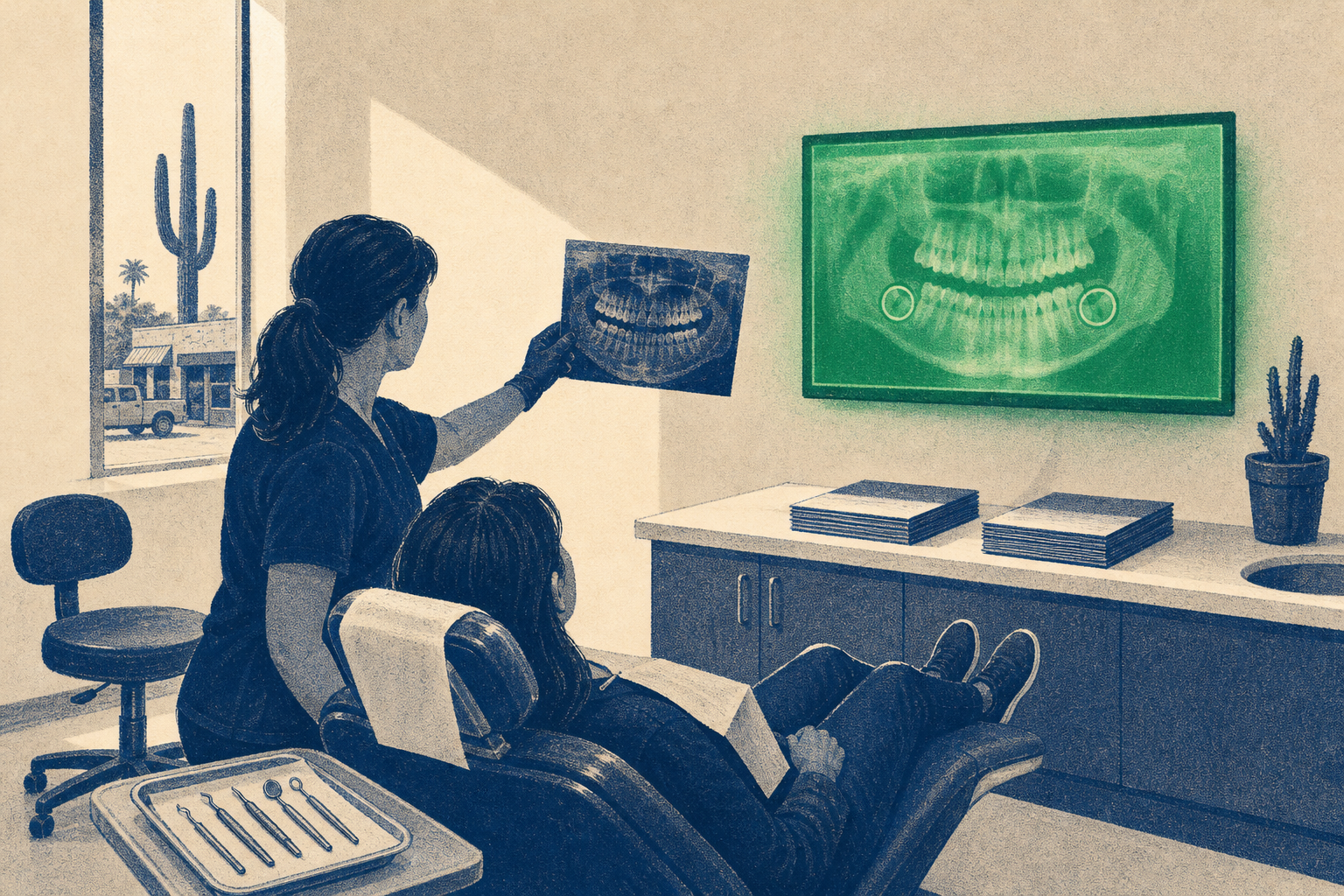
A dental practice in Tempe is making news this week, and not for a whitening special. Cereus Dental Care in Tempe is using AI to analyze patient X-rays, and they are explaining it to their patients in plain English and in Korean. That last part is the detail I want you to sit with for a second.
They are not hiding it. They are not quietly running AI in the background and hoping nobody asks. They built a communication strategy around it, in two languages, because their patient base includes a significant Korean-speaking community. That is not a technology decision. That is a practice management decision, and it says something important about where local healthcare competition is actually headed.
What Cereus Dental is actually doing
AI-assisted X-ray analysis in dentistry is not brand new. Tools like Pearl and Overjet have been on the market for a few years now, FDA-cleared, used by practices and DSOs around the country. What these systems do is flag potential cavities, bone loss, and other findings on a radiograph, the same images a dentist already reads, and surface patterns the human eye can miss or catch a few months later than it could have. The dentist still makes the call. The AI is a second set of eyes that never gets tired at 4 p.m. on a Friday.
What Cereus Dental did that is worth paying attention to is the decision to explain it. In two languages. Proactively. That means they wrote patient-facing communication, probably trained their front desk and their hygienists on how to answer the follow-up questions, and made a deliberate choice to treat AI transparency as a feature of their care, not a liability to manage quietly.
I have been writing about AI adoption in dental and ortho for a while now. A 2026 ADA survey found that 43% of dentists are already using some form of AI in their practice. That number surprised people when it came out. The question was never whether AI would get into the operatory. The question was always who would get there first and what they would do with it when they arrived.
The trust gap, named
Here is the principle I want to name, because I think it applies well beyond dentistry: I call it the Explanation Advantage.
When a new tool shows up in a service business, most operators either hide it or brag about it. The ones who hide it figure patients or customers don't need to know how the sausage is made. The ones who brag about it lead with "next-generation technology" and a stock photo of a robot. Both of those are wrong, and here's why. Patients are not stupid. They are going to find out you're using AI tools eventually, either because they ask, because a competitor tells them, or because they read something online. When they find out on their own, the question in their head is "why didn't they tell me?"
The Explanation Advantage goes to the practice that gets ahead of that question. You tell patients what the tool does, what it doesn't do, and why you chose it. You do it in their language, literally if necessary. Now "AI on my X-rays" goes from a vaguely alarming thing they read about in a headline to something their dentist explained to them personally. That's not a tech adoption story. That's a trust-building story that happens to involve technology.
Cereus Dental built the Explanation Advantage into their practice. In two languages. That's the thing worth copying.
What this means for your practice
If you run a dental, ortho, or any kind of healthcare adjacent practice, here is what this story is actually telling you. The gap between early adopters and everyone else is no longer invisible. It used to be that if a practice two miles away was using a smarter diagnostic tool, you wouldn't know about it and neither would your patients. Now practices are marketing their AI use directly to patients, in the waiting room, on their website, and apparently in the local press. The gap is patient-visible.
That does not mean you need to run out and buy an AI X-ray tool this week. It means you need to have an answer when a patient asks "does this practice use AI?" And right now, a lot of practices don't have that answer ready. Some of them are using AI tools and don't have patient communication around it. Others aren't using any yet and haven't thought about when they will. Both of those are gaps.
On the multilingual piece: if your practice serves a community where a language other than English is spoken at home by a meaningful share of your patients, and you are in metro Phoenix, the odds are high that this applies to you. AI-assisted translation tools are good enough now that patient education materials in Spanish, Mandarin, Tagalog, or Korean are not a major production project. They are a Saturday morning project. The fact that Cereus Dental thought to do it says something about how well they know their own patient community.
Under the hood
For the technically curious: AI X-ray analysis tools in dentistry typically run on convolutional neural networks trained on large labeled datasets of dental radiographs. The FDA clearance process for these tools (Class II, 510(k) pathway) requires the manufacturer to demonstrate that the tool performs at least as well as a licensed clinician on the specific task it is cleared for, usually caries detection or bone level measurement. The AI does not diagnose. It surfaces findings and confidence scores. The dentist reviews them and makes the clinical determination. Pearl, one of the larger players in this space, has published peer-reviewed accuracy data. The tools are not free, typically running on a per-seat or per-image model, but they are not enterprise-only pricing either. Most general practices can fit one into a budget without a capital expenditure conversation.
What to do this week
Three moves, in order of urgency.
- Audit what you're already using. If your practice management software or imaging system has AI features you enabled and never explained to patients, that is the first thing to address. You may already have the Explanation Advantage available to you and just haven't claimed it.
- Draft one paragraph of patient communication. Not a legal disclaimer. One plain paragraph that says what AI tools you use, what they do, and that your provider still makes every clinical decision. If you serve patients in more than one language, get that paragraph translated. This week, not next quarter.
- Look at your digital presence. If a prospective patient Googles "AI dentist Tempe" or "AI dentist [your city]" right now, what comes up? Cereus Dental just got a news story out of this. That is a local SEO signal worth understanding. Practices that are first to stake out that content territory in their market tend to hold it.
Skip it if
Get The Root delivered weekly
We respect your privacy. Unsubscribe at any time.
If you are a solo practitioner running a practice where you personally know every patient by name, where referrals come entirely from relationships and chair-side trust is already exceptional, the AI X-ray tool is not your most urgent problem. Work on the patient communication language anyway, because the question is coming. But you are not losing ground this week.
If you are a multi-location group or a DSO, you should already be piloting this. If you are not, that is a strategy conversation, not a blog post. There are other places AI can run in a practice before you even get to the operatory.
The line I keep thinking about
I have spent a lot of time in rooms where people are deciding whether to tell their customers something uncomfortable. In the auction world, it was condition issues, provenance gaps, fakes dressed up as originals. The operators who disclosed early and explained clearly almost always did better over time than the ones who hoped nobody would ask. The ones who hoped nobody would ask eventually got asked, usually at the worst possible moment.
Cereus Dental is not hoping their patients don't ask about the AI. They wrote the answer out in two languages before the question arrived. That instinct, get ahead of the question, explain it plainly, do it in the patient's language, is not a dental-specific instinct. It is just good business.
So here's the question I'd ask you if we were talking over coffee: if a patient walked in tomorrow and asked "does this practice use AI on my X-rays," do you have an answer ready, and are you proud of it?
Sources
Frequently Asked Questions
See Where Your Business Ranks
Get a free competitive intelligence report. We analyze your website, scan your competitors, and test your AI search visibility, ready in 60 seconds.
Run My Analysis →Did this guide help?
Make our content appear first in your Google Search and AI Overview results by adding us as a preferred source.
Requires signing in to your Google account.
Add Wise Roots as a Google Preferred Source