When I ran an auction house, I learned to tell the difference between a trend and a tipping point. A trend is when a handful of collectors start chasing something. A tipping point is when the price guides catch up. After that, you're not ahead of the market anymore. You're just paying market rate, and if you waited too long, you're playing catch-up on someone else's terms.
The ADA's Health Policy Institute just published their mid-2026 survey of U.S. private-practice dentists, and the numbers in this summary from Artiverse are a tipping point, not a trend. 43.3% of U.S. dentists already use AI for at least one task. Another 26.4% say they plan to. That's nearly 70% of the market either using it or committed to it. The "should I try AI?" question is over for dental. The only question left is whether your practice is in the half that's pulling ahead or the half that's explaining to patients why it isn't.
What the survey actually shows
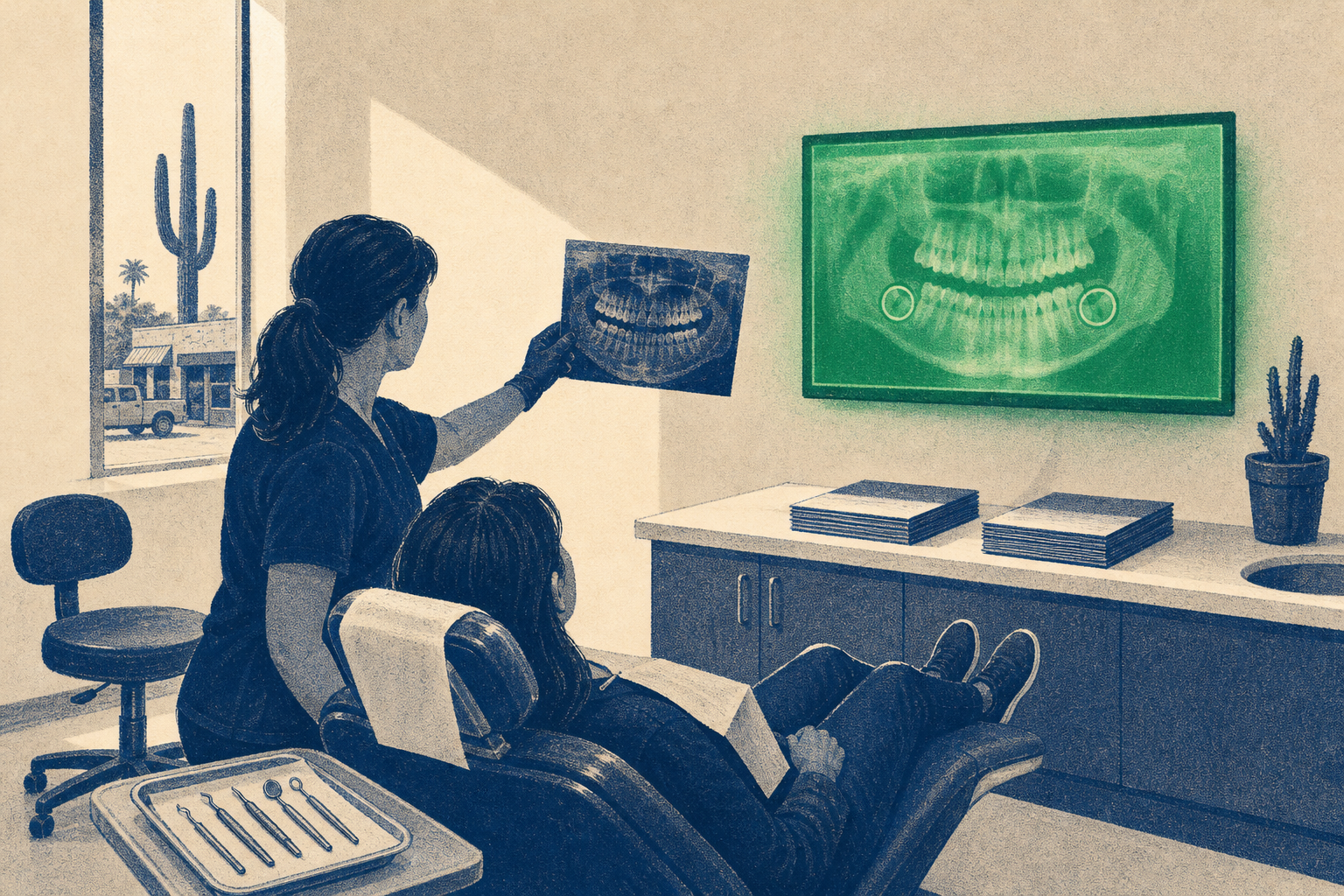
The ADA Health Policy Institute asked private-practice dentists what they're doing with AI right now, and the breakdown is more specific than the headline number. According to the Artiverse report on the survey, imaging and diagnostics lead adoption at 22.8% of dentists. Insurance verification comes in at 13.6%. Explaining clinical findings to patients sits at 13.2%.
Here's the part that stopped me: fewer than 5% of dentists use AI to recommend treatment, and 82.6% say they have no plans to change that. Dentists are not handing their clinical judgment to a machine. They're offloading the stuff that buries them every day: reading images faster, chasing insurance, translating what they found into language a patient can actually understand.
That's a useful distinction. The fear that AI in dentistry means a robot telling you what to drill is not what's happening. What's happening is that AI is handling the work that sits between the clinical decision and the patient hearing about it.
The tipping point test
I use a simple filter with clients I'd call the tipping point test. Two questions. First: has adoption crossed 40% in your industry? Second: are the holdouts choosing to wait, or are they just behind? When both answers are yes, you're no longer an early adopter if you start now. You're just catching up. And in a market where your competitor across the street is reviewing images faster, verifying insurance in seconds, and sending cleaner clinical summaries, catching up is the goal, not the brag.
The ADA survey says the first answer is yes. The 26.4% planning to adopt tells me the second answer is also yes. Most of the holdouts aren't strategically waiting. They just haven't moved yet. That's the tipping point test in dental, and dental just failed it.
Use the tipping point test once more when you look at your own stack: which tasks in your practice still clear 40% manual effort on things AI is already doing next door?
What this means for your practice
Let's put this in plain terms for a practice owner. The three areas where dentists are actually deploying AI right now are:
- Image review. AI analyzes radiographs and scans to flag cavities, bone loss, and early decay. The dentist still makes the call. The AI speeds up the review and catches things that fatigue might miss on a busy Tuesday at 4pm.
- Insurance verification. At 13.6% adoption, this is the admin time sink that practices are killing first. Not surprising. Insurance verification is exactly the kind of repetitive, rule-based task that AI eats for breakfast.
- Patient communication. At 13.2%, this covers explaining clinical findings in plain language. Think auto-generated summaries after the exam, or systems that translate "mesial caries on tooth 14" into something a patient reads and actually understands before they leave the chair.
None of those require you to bet your clinical reputation on a machine. All of them free up your staff for work that actually requires a human in the room.
There's also a pediatric-specific development worth knowing about. A company called Hello Pearl released something called Second Opinion for Kids, a platform that analyzes dental radiographs in real time for children as young as four, and uses animated characters to explain the findings to the kid and the parents. That's a real problem being solved. Anyone who has tried to tell a seven-year-old they have a cavity knows the communication gap is as big as the clinical one.
If you want to think about what the AI receptionist layer looks like for a dental or ortho practice, the patient communication side of this survey is exactly where it connects: follow-up messages, appointment reminders, insurance status updates, post-visit summaries. That's the workflow we've built for practices here in the Phoenix market, and it's not exotic. It's the same pattern the 43% are running.
Under the hood
For the technically curious: the imaging AI in dentistry is mostly computer vision models trained on large sets of labeled radiographs, the same general architecture behind tools like Overjet and Pearl (the company behind Second Opinion for Kids). These aren't large language models making treatment calls. They're classification and detection systems flagging regions of interest, similar to how radiology AI works in medicine. The insurance verification tools are more like structured data extraction: the AI reads the EOB or the payer portal response and populates fields. The patient communication tools are where LLMs actually show up, generating readable summaries from clinical notes. Three different technologies, often grouped under the same "AI" label. Worth knowing so you can ask better questions when a vendor demos something.
Get The Root delivered weekly
We respect your privacy. Unsubscribe at any time.
By the way, the HIPAA liability question is real here. Any AI touching patient data in a dental or ortho practice needs a Business Associate Agreement with the vendor. That's not optional and it's not the vendor's problem if you forget to ask. Ask before you sign anything.
What to do this week
You don't need a big strategy session to start. Three moves that take less time than your next staff meeting:
- Run the tipping point test on your own schedule. Write down the three tasks your front desk touches every day that are purely rule-based: insurance verification, appointment confirmations, post-visit follow-up. Those are your first candidates.
- Ask your imaging software vendor what AI is already in your system. Carestream, Dentsply Sirona, Planmeca and others have been adding AI detection to existing platforms. You may already be paying for something you haven't turned on.
- Look at one patient communication gap. What happens between the visit and the next appointment reminder? If the answer is "we send a text," there's probably an AI layer that makes that text smarter and more likely to keep the patient on schedule.
Skip it if
You're a single-chair practice with a small patient list, a front desk person who handles everything perfectly, and a recall rate you're happy with. There's no rule that says you need to adopt something just because 43% of the market did. The tipping point matters when competition matters. If yours doesn't, you can ignore this one for now and check back in a year.
For everyone else: the question used to be whether AI belonged in a dental practice. The ADA just answered that. The question now is which chair in your waiting room represents the patient your competitor saw faster, documented better, and followed up with first.
Sources
Frequently Asked Questions
See Where Your Business Ranks
Get a free competitive intelligence report. We analyze your website, scan your competitors, and test your AI search visibility, ready in 60 seconds.
Run My Analysis →Did this guide help?
Make our content appear first in your Google Search and AI Overview results by adding us as a preferred source.
Requires signing in to your Google account.
Add Wise Roots as a Google Preferred Source