
Three separate stories landed this week about restaurants and AI, and every outlet treated each one as a quirky consumer reaction piece. Fine. But step back and look at all three together, and there's a pattern that nobody in the restaurant trade press is saying out loud yet.
First: the Wall Street Journal reported this week that restaurants are quietly using AI to reformulate ingredients and cut food costs, and some customers notice that things taste different. Then Adelaide Now ran a piece with a title that is more or less its own thesis: AI-generated food ads look garbage. And NewsNation documented customers calling restaurant AI food photos "slop" and saying the images are alarming enough to make them not order.
The WSJ piece is behind a paywall and I can't link you to the full text, so I'll be straight with you: I'm working from the summary and the framing. What the summary says is clear enough. Restaurants are using AI to cut costs in the kitchen and in the marketing budget, and customers are picking up on both. That's the story. Not the tech. The customer reaction to the tech.
What's actually happening here
Restaurants are under real cost pressure. Food inflation has been brutal, labor costs have climbed, and margins in this industry were already thin enough that you could read a newspaper through them. So when a vendor shows up with a tool that cuts your photography budget or reformulates a sauce recipe to use cheaper inputs, the math looks obvious.
The problem is the other math. The one nobody ran.
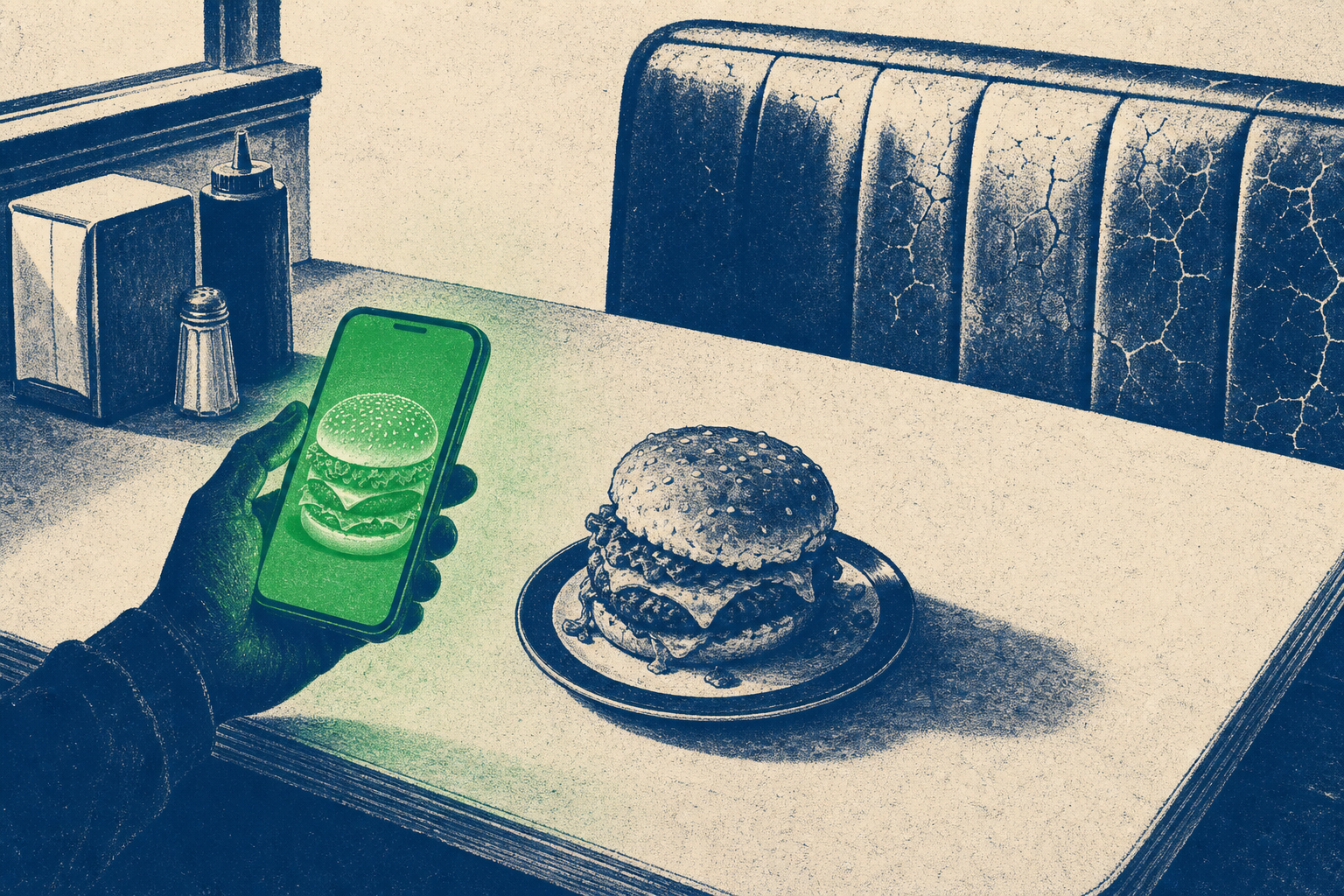
A customer lands on your Google Business profile, or your Instagram, or your DoorDash listing. They look at a photo of your burger. Something is slightly off. The bun has that uncanny sheen. The sesame seeds are too evenly distributed. The tomato slice looks like it was painted by someone who had only ever read a description of a tomato. They don't know what AI image generation is, necessarily. But they know something is wrong. And the thing they decide in that moment is not "hm, curious technical artifact." The thing they decide is "I don't trust this place."
That's the second-order effect that nobody in these stories is naming. I'm naming it now: the credibility tax.
The credibility tax
Here's how it works. Every shortcut that saves you money on the production side has a potential cost on the trust side, and the two columns are almost never measured together. The credibility tax is what you pay in customer confidence for every visible AI shortcut, and it compounds because one bad image doesn't just lose one customer. It gets screenshotted. It gets posted. It becomes a "look at this" moment shared in group chats and on Reddit threads.
I've been watching the trust dynamics around AI-generated images in local business marketing for a while now, and I wrote about an early version of this pattern when restaurants first started leaning on AI faces in their social content. Customers were already voting against AI faces before the restaurant industry noticed. Food images are the same bet, with higher stakes, because food photography is the one piece of visual content that has a direct, documented relationship to purchase intent. People eat with their eyes first. That is not a metaphor. It's why menu engineering is a real profession.
Now layer on the WSJ story. If customers are already uneasy about AI-looking photos, and they're also noticing that dishes taste slightly different because the recipe was reformulated by an AI cost-cutting tool, you have two separate trust signals firing at the same time. The food looks fake. And now, to some customers, it tastes different too. That's not a quirky consumer reaction story. That's a brand erosion story.
What this means for your restaurant, specifically
If you run a restaurant, a food truck, a catering operation, or anything else where a customer looks at a photo before they decide to spend money with you, here is the plain version of what to do.
First, audit every image that is public-facing right now. Your Google Business profile photos, your menu on your website, your social posts from the last six months, any ads running on Meta or Google. If any of those images were generated by AI, or if you're not sure, look at them hard. Zoom in. Show them to someone who doesn't work in your building. Ask them if the food looks real. If they hesitate, you have your answer.
Second, understand that real photos of real food, even imperfect ones taken on a decent phone in good light, are now a competitive differentiator. Not a nicety. Not a "nice to have when budget allows." A differentiator, because the restaurant down the street used the AI photo tool and now their burger looks like a render from a video game. Your actual burger, photographed honestly, wins that comparison.
Third, if you are using any vendor tool that touches your recipe formulation or ingredient sourcing, ask them directly whether AI optimization is part of their process. You have a right to know what's in your supply chain, and your customers have a right to get what they ordered. The WSJ summary doesn't name specific vendors, and I won't speculate, but the question is worth asking at your next contract renewal.
On the trust-building side more broadly, this is exactly the kind of moment where local trust signals do real work. Reviews with photos from real customers. Behind-the-scenes content showing real kitchens and real prep. The unglamorous stuff that proves you are who you say you are.
Under the hood, for the curious
The AI food photo tools that restaurants are using fall into two categories. The first is generative image tools (Midjourney, DALL-E, Adobe Firefly, and a dozen others) used to create images of dishes that either don't exist or are idealized versions of what you actually serve. The second is AI-enhanced photography tools that take a real photo and "improve" it, smoothing textures, saturating colors, adding false highlights. The second category is older and more normalized, but the current generation of enhancement tools has crossed a threshold where the results look wrong to a trained human eye at a glance.
Get The Root delivered weekly
We respect your privacy. Unsubscribe at any time.
The ingredient reformulation tools the WSJ describes are a separate category entirely. These are optimization models that analyze recipe costs and suggest substitutions to hit a target margin. The outputs can be imperceptible, or they can be noticeable. The point is that the customer is the one doing the quality control, which is not a great system.
What's new isn't any single tool. It's the convergence: more restaurants using more of these tools at once, right as customer sophistication about AI artifacts is rising fast. The window where this stuff went unnoticed has closed.
What to do this week
- Pull up your Google Business profile on your phone and look at every photo in your listing. Remove anything that looks generated or over-processed. Replace it with real photos, even if you have to take them yourself today.
- Check any active ads. If a vendor produced the creative and you didn't see the original photography session, ask for the source files.
- If you're using an AI content tool to produce menu copy or promotional images, make sure there's a human reviewing every output before it goes public. Not for grammar. For "does this look like real food."
- Watch your reviews for any mention of food tasting different or photos looking different from what arrived. That's your early warning system.
Skip it if
You run a ghost kitchen or delivery-only operation where your brand is built entirely on packaging and reviews rather than visual identity. The calculus is slightly different when there's no dining room and no walk-in traffic making a snap judgment. You still care about trust, but the food photo problem is less acute than it is for a full-service restaurant trying to fill seats.
The line I keep coming back to
There's an old rule in the auction business: the fastest way to kill a room is to sell something that doesn't match its description. Bidders stop bidding. They start whispering. The energy in the room changes, and you don't get it back that night. What restaurants are doing with AI food photos is the digital version of that. The customer looked at the picture. Then they looked at the plate. Those two things have to match, or the room goes quiet.
So let me ask you a peer question, the kind I'd ask over coffee: when did you last look at your own restaurant's photos the way a stranger would, someone who has never eaten your food and is deciding right now whether to try it?
Sources
Frequently Asked Questions
See Where Your Business Ranks
Get a free competitive intelligence report. We analyze your website, scan your competitors, and test your AI search visibility, ready in 60 seconds.
Run My Analysis →Did this guide help?
Make our content appear first in your Google Search and AI Overview results by adding us as a preferred source.
Requires signing in to your Google account.
Add Wise Roots as a Google Preferred Source