
Toast published something this week that I rarely see from a software company: actual usage data, not projections. The 2026 Restaurant AI Report, covered by Restaurant Dive, pulls aggregated, anonymized prompt data from Toast IQ, the AI assistant baked into the Toast platform, across Q2 2026 (April through June). It covers U.S. restaurant locations only. And it tells you something that no vendor deck ever will: what managers are actually doing with AI versus what anyone promised they'd do.
Fair warning: this is sponsored content from Toast, so read the methodology footnotes the way you'd read the back of a cereal box. The findings are still worth your time, because the pattern they reveal is real, and I've watched the same pattern play out in the restaurant work we do here in Phoenix.
What the data actually says
The headline number is this: fine dining managers sent 67% more prompts per location than fast casual managers. Full-service restaurants sent 41% more, casual full-service 38% more, and pizzerias 33% more. The more moving parts a concept has, the more managers lean on the tool.
But the number that stopped me was this one: 53% of all prompts landed during peak lunch or peak dinner service, against 15% at nightly close. Only 13% came in during the mid-day lull. Morning prep accounted for 19%.
Think about that for a second. Managers aren't pulling reports the next morning to understand what went wrong. They're asking questions while the night is still happening, while there's still time to do something about the answer.
Sales and revenue questions made up 30% of all threads. Menu and inventory questions came second, and about 12% of those included a request for a change right in the chat, most often marking an item out of stock. Fine dining managers directed 8% of their sales threads toward server performance, nearly four times the fast casual rate. And 29% of their loss-prevention questions were about manager comps, double the platform average.
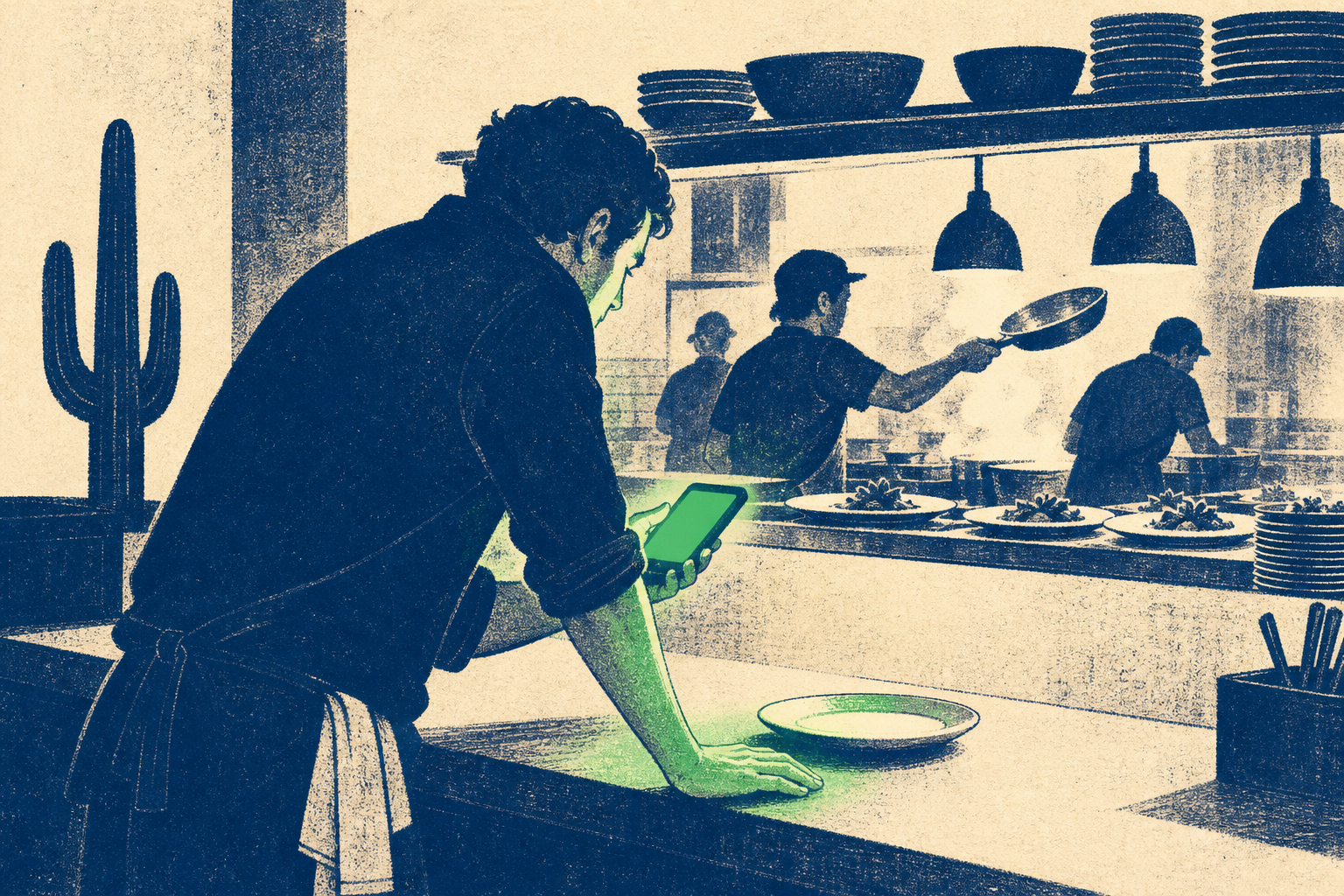
On device: 54% of user-initiated AI interactions came from mobile, not desktop. Sales prompts made up 40% of mobile activity versus 19% on desktop. Labor and staffing prompts ran 32% higher on mobile than on desktop.
The two-clock problem (and why it's the real lesson here)
The report frames something I'd call the two-clock problem. Every restaurant runs on two clocks. One shows when something happened. The other shows when you found out. The gap between those two times is what it costs you.
An item runs out at 6:45 p.m. You find out at 8:30 p.m. when a server gets embarrassed in front of a four-top. That gap cost you table time, server credibility, and probably a comp. A clock-in error happens Monday morning. Payroll catches it Friday. That gap cost you hours of reconciliation and, depending on the state, maybe a penalty.
The two-clock problem is not new. I spent two decades running an auction company, and the version we dealt with was simpler: I'd find out what something was worth the day after I'd already priced it wrong. The fix, then and now, is the same. You need the information while the decision is still open.
What Toast's data shows is that managers are using AI specifically to close the gap between those two clocks. Not to analyze last quarter. Not to build a strategy deck. To find out right now whether the overtime is running hot, whether a comp looks suspicious, whether an item needs to come off the board before the next ticket drops.
The vendors will tell you AI is for forecasting and labor optimization and marketing personalization. And eventually, sure. But the managers in this data are using it the way a chef uses a thermometer: in the moment, to make a call.
What this means for your restaurant
If you're running a restaurant and you haven't thought about what tool you'd use to ask a real question during service, that's the gap worth closing first. Not an enterprise AI strategy. Not a year-long implementation. A tool your manager can pull up on their phone at 7 p.m. and ask: "What's my labor percentage right now and who's close to overtime?"
Toast IQ is built into the Toast platform, so if you're already on Toast, you may have access and just aren't using it yet. If you're not on Toast, the lesson still applies: the question isn't whether your POS vendor has an AI assistant. The question is whether your managers can get a real answer about what's happening on the floor while they can still do something about it.
Fast casual operators, the data shows your peers are asking about payment and tender breakdowns and cross-location performance. If you run multiple locations, that's worth noting. Fine dining operators, your peers are watching server performance and manager comps mid-shift. If that's not happening at your place, you know what to add to the conversation with your floor manager tonight.
For the context on what else Toast has been building into the platform, I covered their AI agents for scheduling and marketing a few months back. The usage data from this report fits right alongside that picture.
Under the hood (for the operator who wants the fine print)
A few things worth knowing about the methodology before you quote these numbers to anyone. The report covers prompts only, meaning the questions and requests entered into Toast IQ. It does not measure whether any resulting actions were completed. When it says 12% of menu questions included a request for a change, that means the manager typed a change into the chat. It does not confirm the change was saved in the product. Toast says as much in their own footnotes.
Get The Root delivered weekly
We respect your privacy. Unsubscribe at any time.
Topic categories were assigned by keyword and phrase matching against prompt text, not by a built-in product taxonomy. So "sales and revenue at 30%" is an approximation, not a hard count from a pre-labeled database. That's standard for this kind of analysis, but it means the percentages are directionally right, not precise to the decimal.
Also: this is sponsored content published by Toast. The findings are consistent with what I'd expect from real operational behavior, but the framing is designed to make Toast IQ look useful. It probably is useful. That doesn't mean the report is an independent audit.
With all that said, the pattern holds. And patterns from real usage data are more useful than any vendor's projection slide.
What to do this week
- Run the two-clock check tonight. Pick your three busiest pain points from last week (an item that ran out, a labor overage, a comp that surprised you) and write down when each thing happened versus when you found out. That lag is your baseline. Now ask whether any tool you currently have could have closed it.
- If you're on Toast, open Toast IQ during your next dinner rush. Not before it, not after. During. Ask it something real: labor right now, item stock, server performance for the shift. See what it gives you and how fast.
- If you're not on Toast, ask your current POS vendor the same question. Can your managers get a real-time answer about labor or sales from a phone during service? If the answer is a 45-second login and three menu clicks, that's your answer about where you stand.
- Think about the device. 54% of these queries came from mobile. If your managers have to walk to a back office terminal to check something, the friction is the problem. The tool doesn't have to be AI to fix that, but AI assistants are increasingly the fastest path to an answer that's already in your POS data.
Skip it if
You run a single-location counter-service concept with a manager who already knows every number by feel and a POS that gives you a clean end-of-day report. The two-clock problem exists for you, but the stakes per gap are lower, and the ROI on a new tool is harder to justify. Watch this space in 12 months.
The question I'd ask a peer
Here's what I keep coming back to. The managers in this dataset are asking AI questions during the dinner rush, from their phones, while the answer can still change the outcome. The question isn't whether AI is coming to restaurants. It's already there, in production, at scale. The question is what clock your managers are running on tonight.
An AI that answers you after the shift is a report. An AI that answers you during the shift is a manager. You get to decide which one you want at your place.
Sources
Frequently Asked Questions
See Where Your Business Ranks
Get a free competitive intelligence report. We analyze your website, scan your competitors, and test your AI search visibility, ready in 60 seconds.
Run My Analysis →Did this guide help?
Make our content appear first in your Google Search and AI Overview results by adding us as a preferred source.
Requires signing in to your Google account.
Add Wise Roots as a Google Preferred Source