
Earlier this week, Anicca Digital's weekly AI roundup dropped a number that should stop every local business owner mid-scroll: according to new Semrush research cited by Search Engine Land's Danny Goodwin, Google AI Overviews now appear for 88% of commercial keywords on US desktop searches. That's up from 45.75% a year ago. Nearly double. In twelve months.
Okay. Take a breath. Because this is not a "interesting trend to watch" stat. This is the kind of number that makes a decade of SEO advice obsolete before your next quarterly review.
What Actually Happened
Semrush tracked 400 US desktop commercial keywords through August 2026. Here's what they found, per Search Engine Land:
- "Best X for Y" review queries hit 96.12% AI Overview coverage.
- "Brand vs. brand" comparison queries rose 23 points to 86%.
- "Brand alternatives" queries rose 34 points to 82%.
- Ecommerce saw the steepest jump of any industry, from 33% to 85%.
- When weighted by actual search volume, AI Overview coverage reached 97% in August.
- The 12% of keywords without an AI Overview accounted for less than 3% of total search volume in the sample.
Read that last line again. The searches where Google still shows you the old blue-link experience represent 3% of the volume. Three.
Separately, Search Engine Land's updated GEO guide, written by Leigh McKenzie, pulls in Semrush AI Visibility Index data showing that 40 to 60% of cited sources inside ChatGPT and Google AI Mode change every single month. The brands that stay cited consistently share three traits: entity clarity (Google knows exactly who you are and what you do), content extractability (your answers are easy for AI to pull and paraphrase), and multi-platform presence (you show up in more than one place).
Meanwhile, MarTech's Becky Simms noted that AI search is also changing how customers phrase buying intent. Where Google used to get "best dentist Scottsdale," AI assistants now get "I need an orthodontist in north Scottsdale for my teenager who is anxious about braces and we have Delta Dental." That is a completely different signal, and most businesses have no idea it's happening.
The Citation Shelf Problem, Named
Here's the framework I'm using with clients right now. I call it the citation shelf.
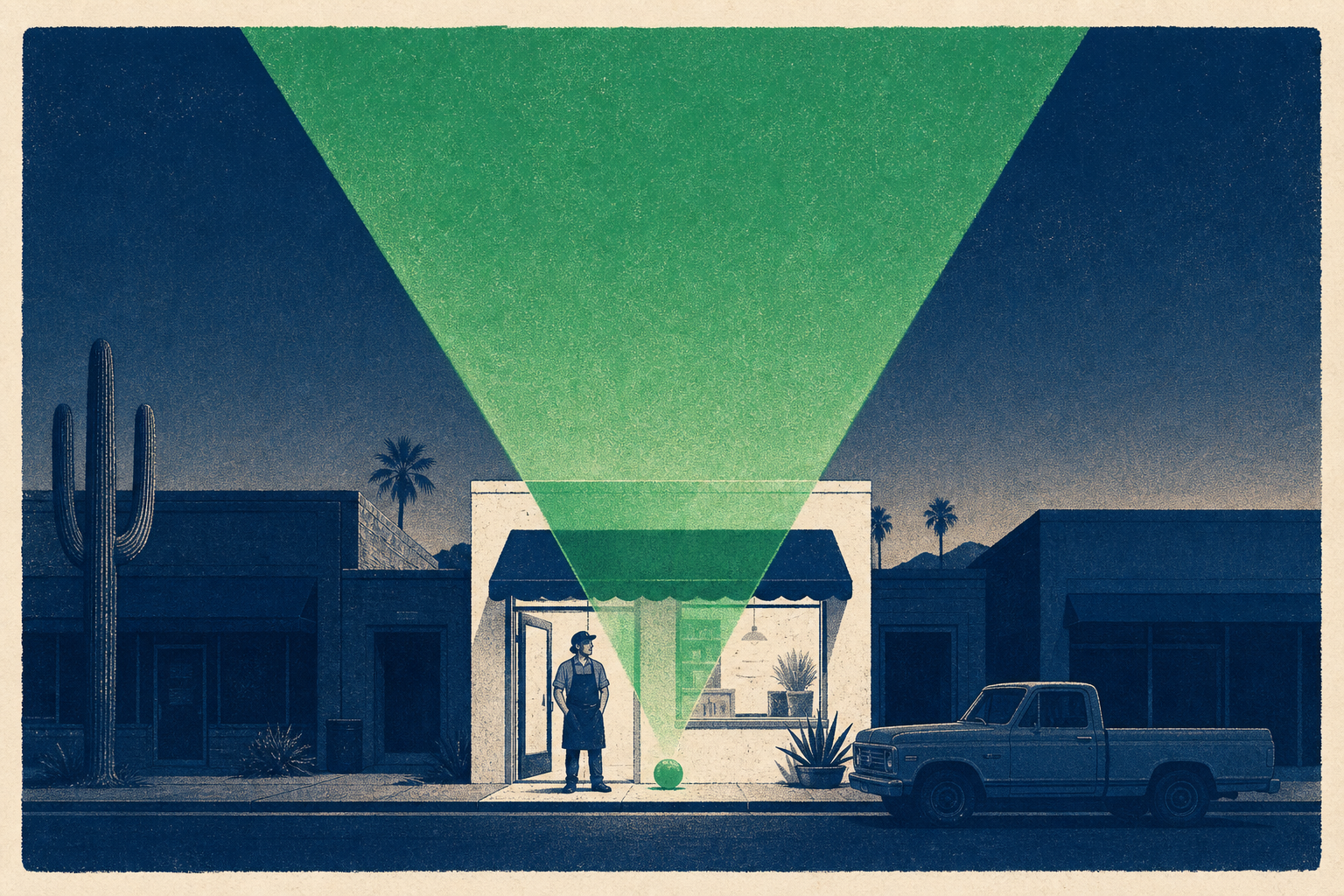
Think of AI Overviews and ChatGPT answers the same way you'd think of the shelves at a grocery store. Google and OpenAI are the buyers. Your content is the product. To get on the shelf, you need three things: the buyer has to know exactly what you sell (entity clarity), they have to be able to grab it quickly (content extractability), and they need to see it at more than one distributor so they trust it's real (multi-platform presence).
Most local businesses have none of these three. They have a website written for humans to read, a Google Business Profile that hasn't been touched since 2023, and maybe a Yelp listing. That is not a product that gets on the citation shelf. That is a product sitting in a warehouse with no label on it.
Run the citation shelf test on your own business this week. You either meet the three criteria or you don't. There is no partial credit when an AI is deciding in milliseconds whether to mention you.
What This Means for Your Business
If you run a restaurant, a dental practice, a med spa, a law firm, a home services company, or any other local business that gets customers from Google search, your 2027 marketing plan has a structural problem if it still centers on "ranking higher."
Ranking higher on what? On the blue links that show up below an AI answer that already told the searcher what they wanted to know? That is not where the customer's attention is going.
The shift is specific and it is already here. "Best orthodontist in Tempe" now returns an AI Overview that names three practices, summarizes their reviews, and tells the reader what to expect. The person reading that may never scroll down to your listing at all. We wrote about one practice that figured this out early over at Cereus Dental in Tempe. The practices getting cited are not necessarily the ones with the most backlinks. They are the ones whose content answers the question cleanly.
The research from The Drum's Saskia Welch, citing Gilroy's analysis of 174,745 online opinions from UK B2B marketing revenue leaders, adds a sharp warning here: 80% of opinions in their data suggest AI search attribution is not currently being validated against CRM data. Only 20% referenced any cross-check. That means most businesses chasing "AI visibility" have no idea whether it is actually producing customers. Don't optimize for a metric you can't connect to revenue. Get cited, yes. But build the measurement loop first.
Under the Hood
For the technical reader: what Semrush is measuring is trigger rate, meaning what percentage of queries cause Google to render an AI Overview module at all, not click-through rates or citation frequency within those overviews. Those are three different numbers, and conflating them is how bad strategy gets built. An 88% trigger rate tells you the module is almost always there. It does not tell you whether your brand is inside the module, or whether the user clicked anything afterward.
The volatility data from the GEO guide (40 to 60% of cited sources changing monthly) suggests AI Overviews are not static rankings. They behave more like a dynamic retrieval system than a fixed SERP position. That means you cannot "rank" in the traditional sense. You can only become more consistently citable by meeting the citation shelf criteria repeatedly, across more content and more platforms, over time. The content strategy implications are real: structured formats (comparison tables, clear definitions, FAQ sections) outperform narrative prose for extractability. Your content team needs to know this.
For context on scale: Search Engine Land's GEO guide notes ChatGPT now reaches 1.2 billion weekly users and Gemini has crossed 1 billion monthly users. These are not niche tools anymore. These are where a meaningful chunk of your potential customers are already doing research.
Get The Root delivered weekly
We respect your privacy. Unsubscribe at any time.
What to Do This Week
Two moves. Not ten. Two.
Run a prompt audit. Open ChatGPT, Gemini, and Google AI Overviews. Type in 10 to 15 searches your best customers would actually type: "best [your service] in [your city]," "[your service] vs [competitor service]," "[your service] for [specific customer situation]." Write down who gets cited. If it is not you, study what is getting cited and why. That is your content gap list. Our piece on how Ameresco rewrote its content for AI search shows exactly what that process looks like when someone commits to it.
Audit your Google Business Profile and your on-site structure. Entity clarity starts with making sure Google knows unambiguously what you do, where you do it, and who you serve. Update your GBP categories, add services with descriptions, and make sure your homepage says your city and your specialty in plain language in the first paragraph. Then add a FAQ section to your most important service pages. Not for humans. For AI extractability. Our local SEO services page covers what this looks like in practice if you want a starting point.
Skip It If
You get all your business from referrals, repeat customers, or direct relationships, and you have never meaningfully tracked organic search as a source of new patients or clients. If Google has not been working for you anyway, this particular shift is not your most urgent problem. Focus on the referral engine. Come back to this when you are ready to add a search channel.
The Question I'd Ask a Peer
The old SEO question was "where do we rank?" The new question is "do we get cited?" Those are not the same race. Most businesses don't know the answer to the new question yet, which means most businesses are running the old race on a track that is almost entirely paved over.
So here's what I'd ask you, the same way I'd ask it over coffee: if a potential customer asked ChatGPT right now whether they should hire you, what would it say? Go find out. That answer tells you more about your marketing situation than any rank report your agency sent you last month.
The searchable customer isn't going through ten blue links anymore. The citation shelf is where the buying decision gets made. You can't get on a shelf you haven't stocked.
Sources
- This Week in AI in Marketing and Management (26th Oct 26), Anicca Digital, Ann Stanley
- Google AI Overviews Nearly Double for Commercial Keywords, Search Engine Land, Danny Goodwin, October 22, 2026
- Search Engine Land Updates Its GEO Guide: Up to 60% of AI Citations Change Every Month, Search Engine Land, Leigh McKenzie, October 21, 2026
- AI Search Is Turning Prompts Into Customer Research, MarTech, Becky Simms, October 20, 2026
- AI Search Is Creating a New Accountability Problem for CMOs, The Drum, Saskia Welch / Gilroy, October 19, 2026
Frequently Asked Questions
See Where Your Business Ranks
Get a free competitive intelligence report. We analyze your website, scan your competitors, and test your AI search visibility, ready in 60 seconds.
Run My Analysis →Did this guide help?
Make our content appear first in your Google Search and AI Overview results by adding us as a preferred source.
Requires signing in to your Google account.
Add Wise Roots as a Google Preferred Source