
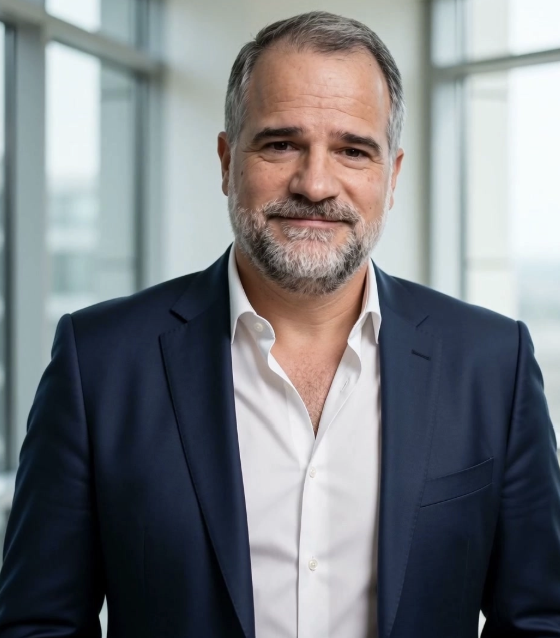

The CEO of the company running AI voices on customer calls for Klarna, Deutsche Telekom, Cisco, Adobe, and a growing list of governments sat down with TechCrunch this week and said something owners should hear. Mati Staniszewski, co-founder and CEO of ElevenLabs, told reporter Connie Loizos that businesses using AI voices on customer calls should disclose it. His exact words: "I think there should be disclosure at this time."
That is a remarkable thing to say when your company is reportedly valued at $22 billion and pacing at $600 million in annual recurring revenue, and the product you sell is an AI voice that sounds human. He is, in effect, telling his own customers to be more transparent about using his product. When the person who profits from your silence tells you to speak up, I'd listen.
What actually happened this week
Staniszewski gave a short interview at Nrth, a Toronto entrepreneurship conference, where he covered a lot of ground fast. The relevant part for local business owners is the disclosure question. His full answer to TechCrunch: "Currently, people aren't used to it, and the common pattern is you don't want to feel cheated on that call. But in five years, when everybody has their own agent working on their behalf, you'll be calling in and expecting an agent. Then I think we'll shift as a society."
He also described what good disclosure looks like in practice: "If there's a 30-minute wait for a human, offer the customer a choice. In almost all cases, they choose the agent and then they're surprised by how good the experience is."
That is not a hypothetical. ElevenLabs says it's powering first-line phone support for 35 million U.S. Klarna customers, plus a deployment in Poland where AI agents call patients across the public health system to reduce no-shows (the baseline was 18% of patients not showing up, and the AI reminder calls moved that number). This is not a startup demo. It's live, at scale, right now.
The lesson, named: the Disclosure Window
Right now you have a choice about how to handle disclosure. In a couple of years, you probably won't. Regulators in the EU already have AI transparency requirements baked into the AI Act. The FTC has been watching this space. Several U.S. states have introduced or passed laws requiring disclosure when a bot is conducting a call. The Disclosure Window is the short period you have to get ahead of this on your own terms, before someone else dictates the terms for you.
I've seen this pattern before. About a decade ago, brands that put "this is a paid partnership" at the top of influencer content voluntarily were treated as trustworthy when the FTC finally made it mandatory. The ones who waited looked like they'd been caught. The rule didn't change the behavior. It just changed who looked good and who looked guilty.
The Disclosure Window closes when regulation arrives or when a local news story runs about a business that "tricked" customers with a robot voice. Either one will cost you more trust than the disclosure ever would have.
What this means for your business
If you're running an AI receptionist on your phones, answering appointment calls, handling after-hours inquiries, or doing outbound appointment reminders, you are already in this conversation. You may not be using ElevenLabs specifically (there are several companies in this space), but the product category is the same. An AI voice is handling calls that used to go to a person.
The cost argument is real. A competent human receptionist in Phoenix runs $3,500 to $4,500 a month in salary plus benefits. AI phone coverage, including after-hours and overflow, runs a fraction of that. The math is why adoption is happening fast. The trust question is why disclosure matters.
Who this is for, specifically: dental and ortho practices running AI reminder calls, home services companies using AI to answer inbound leads after hours, med spas handling appointment confirmations, any professional services firm that has deployed an AI phone agent to handle first contact. If that's you, the Disclosure Window is open and you should use it.
And if you're wondering how customers respond to AI in other parts of your business, the data from restaurants is a useful read: transparency consistently outperforms concealment when customers eventually find out.
Under the hood
ElevenLabs is not just a text-to-speech tool. Staniszewski described the goal as passing the Turing test for conversational AI, which requires combining intelligence with emotional intelligence: detecting the caller's emotional state, slowing down or speaking up accordingly. That hasn't been done yet, he said, but they're working toward it. The "reasoning layer," meaning the large language model that decides what to say, is actually a menu of options in ElevenLabs' platform. Simpler informational calls can run on open-source models. High-stakes interactions, like financial services or anything requiring authentication, still use frontier models because there's no room for error. The voice layer and the reasoning layer are modular. That architecture is what lets them serve both a Polish government healthcare deployment and a Scottsdale med spa from the same platform.
Get The Root delivered weekly
We respect your privacy. Unsubscribe at any time.
They also have thousands of contractors annotating training data, not just for what was said but for how it was said, what emotions were present, and accent accuracy. That's how voice AI gets good enough that callers don't notice. Which is, circling back, exactly why the Disclosure Window matters.
What to do this week
- Audit your phones. Does any part of your inbound or outbound call flow use an AI voice? If yes, move to step two.
- Add a one-sentence disclosure. It does not need to be dramatic. Something like: "You've reached [Business Name]. Our AI assistant is here to help, and a team member is always available if you prefer." That's it. Staniszewski's model: offer the choice. Customers pick the AI anyway.
- Check your state's rules. Several states have passed or are moving on AI disclosure requirements for phone calls. A quick search for "[your state] AI disclosure telephone" will tell you where things stand. Don't wait for your vendor to tell you. They have an incentive to keep it quiet.
- Build disclosure in from day one if you're planning to deploy AI phone coverage in the next twelve months. It is much easier to start transparent than to retrofit it after customers have already called.
You can skip this one if:
You have no AI in your customer-facing phone or chat flows and no plans to add any in the next year. This is not your problem yet. Bookmark it and come back when you're ready to deploy.
The line that stayed with me
Staniszewski said customers who are offered the choice between a 30-minute wait for a human and an AI agent "almost always choose the agent, and then they're surprised by how good the experience is." That's the whole story. The problem isn't the AI. The problem is the ambush. Give people the choice, and they make the sensible one. Take away the choice, and you've made an enemy out of someone who would have been a fan.
So here's the question I'd actually ask you over coffee: if a customer found out tomorrow that your phone system uses AI and you hadn't mentioned it, would they feel cheated or would they shrug? Your honest answer tells you exactly how much runway you have left in the Disclosure Window.
Sources
Frequently Asked Questions
See Where Your Business Ranks
Get a free competitive intelligence report. We analyze your website, scan your competitors, and test your AI search visibility, ready in 60 seconds.
Run My Analysis →Did this guide help?
Make our content appear first in your Google Search and AI Overview results by adding us as a preferred source.
Requires signing in to your Google account.
Add Wise Roots as a Google Preferred Source