
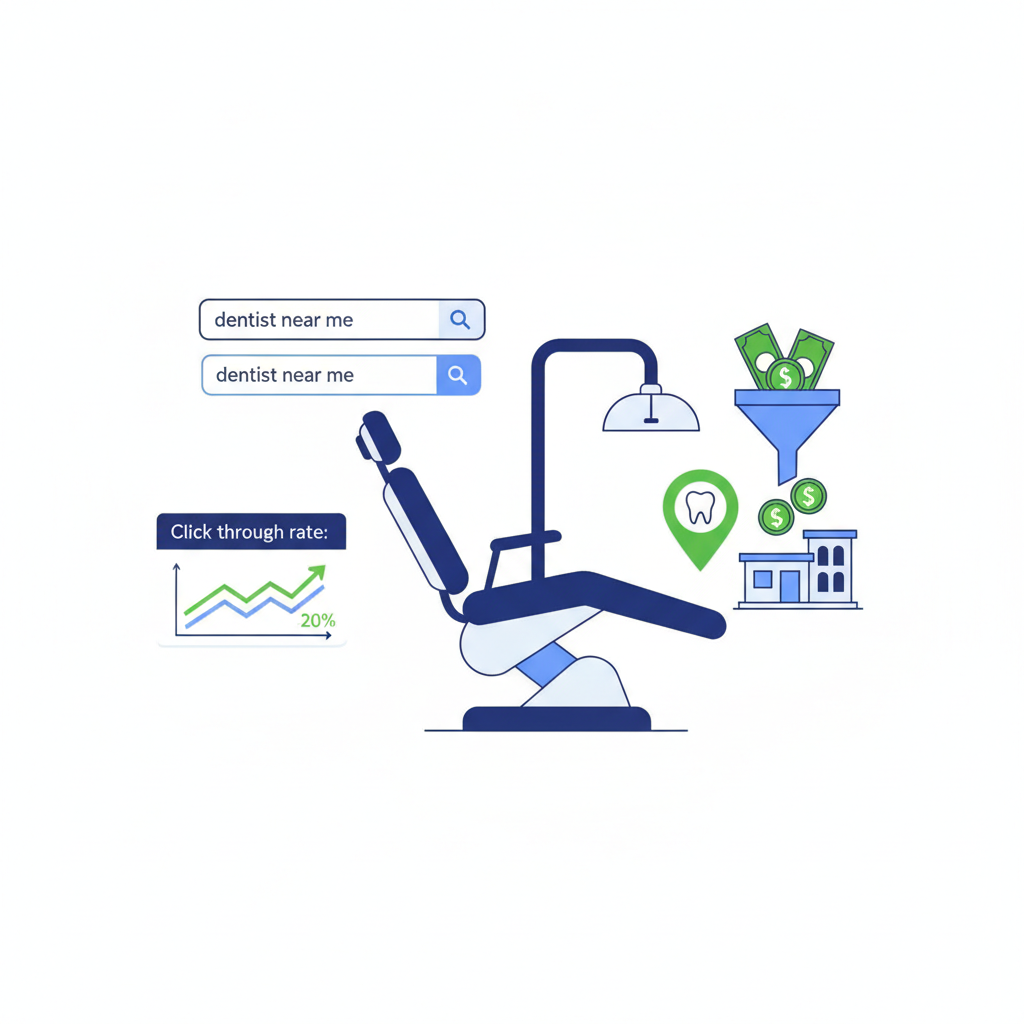
Phoenix has more dental practices per capita than almost any city in the Southwest. That means the competition for new patients on Google is brutal, and expensive. Most practices are spending $1,500-3,000 a month on Google Ads and have no idea which campaigns are producing actual patients versus burning money on the wrong clicks.
I've managed Google Ads for dental and orthodontic practices for years. I also built an AI platform called RICHARD that's deployed inside an active orthodontic practice. So when I say your Google Ads are probably leaking money, I'm saying it from experience, not theory.
Here's where the leaks are and how to fix them.
The 3 Most Common Dental Google Ads Mistakes in Phoenix
1. Bidding on "dentist near me" without tight radius targeting.
This is the most expensive mistake I see. "Dentist near me" is a high-volume keyword, and most agencies bid on it with a 25-mile radius around your practice. The problem: patients don't drive 25 miles to a dentist. Your realistic catchment area is 5-10 miles, maybe 15 for a specialist like an orthodontist.
Every click from a patient 20 miles away is wasted budget. They're not coming to you. They searched, clicked your ad, looked at your address, and left. You paid for that click. Fix this by tightening your radius targeting to your actual service area and using bid adjustments to prioritize the zip codes closest to your office.
2. Sending all traffic to the homepage.
Your homepage is designed to do a dozen things: introduce your practice, list your services, show your team, display your hours. That's too many choices for someone who just searched "Invisalign Scottsdale" and wants to know if you offer it, what it costs, and how to book a consultation.
Every Google Ads campaign should drive to a dedicated landing page built for that specific intent. An Invisalign campaign drives to an Invisalign page. A new patient campaign drives to a new patient page with a booking form above the fold. A teeth whitening campaign drives to a whitening page. Your conversion rate will improve immediately.
3. Not separating emergency from elective campaigns.
Someone searching "emergency dentist Phoenix" at 9 PM has completely different intent than someone searching "cosmetic dentist Scottsdale" on a Tuesday afternoon. The first person needs help right now and will call the first practice they find. The second person is researching, comparing, and will take days to decide.
These require different bidding strategies, different ad copy, different landing pages, and different conversion tracking. Most agencies run them in the same campaign with the same settings. That means your emergency keywords (which have high click-through but low patient lifetime value) eat the budget that should be going to elective and cosmetic keywords (which have lower volume but much higher patient value).
What Dental SEO Actually Looks Like in 2026
Google Business Profile is now the most important piece of real estate for dental searches. When someone searches "dentist Phoenix," Google shows the map pack first. If you're not in those top 3 map results, you're invisible to most searchers.
Optimizing your GBP means keeping your hours current, responding to every review, posting weekly updates, adding photos regularly, and making sure your categories and services are correctly tagged. This sounds basic, but I audit dental GBP profiles every week and most are half-done.
Beyond GBP, you need to think about two keyword categories. Generic keywords like "dentist Phoenix" and "dentist near me" drive volume. Treatment-specific keywords like "Invisalign Phoenix," "teeth whitening Scottsdale," and "dental implants Mesa" drive higher-intent traffic. You need both, but treatment-specific pages on your website are where most practices fall short.
AI search is changing the landscape too. When a potential patient asks ChatGPT or Google Gemini "Who's the best orthodontist in Scottsdale," the AI pulls from your website content, your reviews, and your online authority. If your site isn't structured with clear, detailed content about your services, your providers, and your results, the AI has nothing to cite. This is Answer Engine Optimization, and it's becoming as important as traditional SEO.
What Happens After the Lead Comes In
Most practices spend everything on acquiring the patient and nothing on the follow-up. A new patient inquiry comes in at 4:55 PM on a Friday. Nobody calls back until Monday. By then, they've already booked with the practice that answered Saturday morning.
Get The Root delivered weekly
We respect your privacy. Unsubscribe at any time.
This is the problem RICHARD was built to solve. It's an AI platform I deployed inside an active orthodontic practice in St. Louis. Five modules: INTAKE automates new patient onboarding with a 99.2%% completion rate. PULSE delivers weekly practice performance dashboards. TRACTION follows up on treatment plans that haven't been scheduled. SPARK tracks which marketing channels produce the highest-value patients. SLEEP handles after-hours communication so your practice never goes dark.
I'm not turning this into a sales pitch. The point is simpler: your marketing budget is only as good as your follow-up system. If you're spending $3,000 a month on Google Ads and losing 30%% of those leads to slow response times, you don't have a marketing problem. You have an operations problem.
What to Look for in a Dental Marketing Partner
Industry-specific experience matters more in dental than almost any other vertical. HIPAA-adjacent ad restrictions, seasonal patient patterns (back-to-school ortho, January insurance resets, summer cosmetic procedures), and patient lifetime value calculations all require someone who has done this before.
Make sure you own your own ad accounts. Google Ads, Meta Business Manager, Google Analytics, Google Business Profile. If an agency sets these up under their own accounts and won't transfer them when you leave, that's a red flag.
Demand clear ROAS tracking tied to actual new patient appointments. Not clicks. Not form fills. Patients who showed up, sat in the chair, and started treatment. If your marketing partner can't connect their work to that outcome, they're not measuring what matters.
Before You Change Anything
If you're spending money on dental marketing and not sure what's working, start with data. Visit our dental marketing page to see how we approach dental and orthodontic campaigns specifically.
Or get a free competitive brief for your practice. We'll show you what competing dental practices in your area are running, where they're spending, and where the gaps are.
Book a strategy call with Josh → He built an AI platform for an orthodontic practice. He knows this space.
See Where Your Business Ranks
Get a free competitive intelligence report. We analyze your website, scan your competitors, and test your AI search visibility, ready in 60 seconds.
Run My Analysis →Did this guide help?
Make our content appear first in your Google Search and AI Overview results by adding us as a preferred source.
Requires signing in to your Google account.
Add Wise Roots as a Google Preferred Source