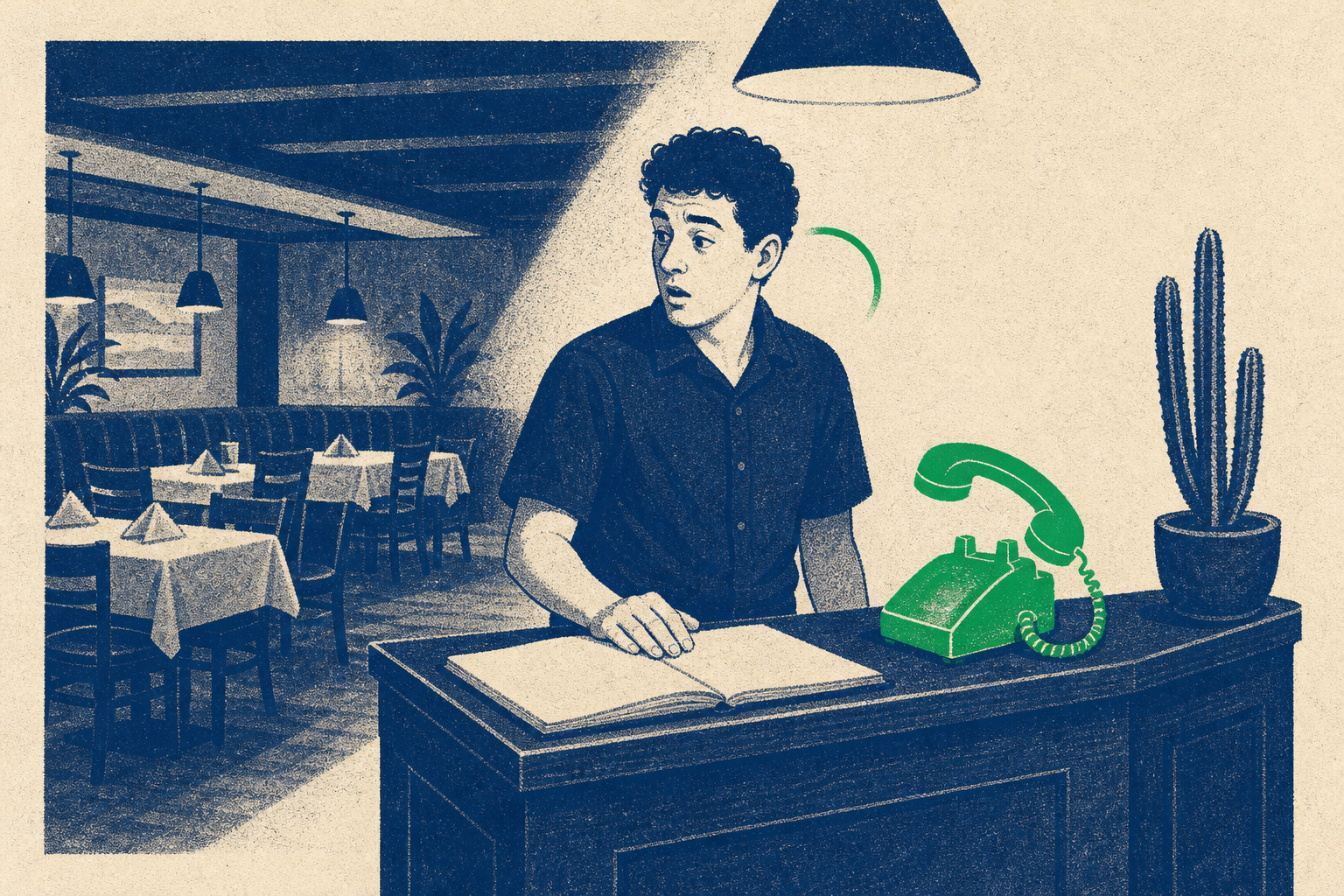

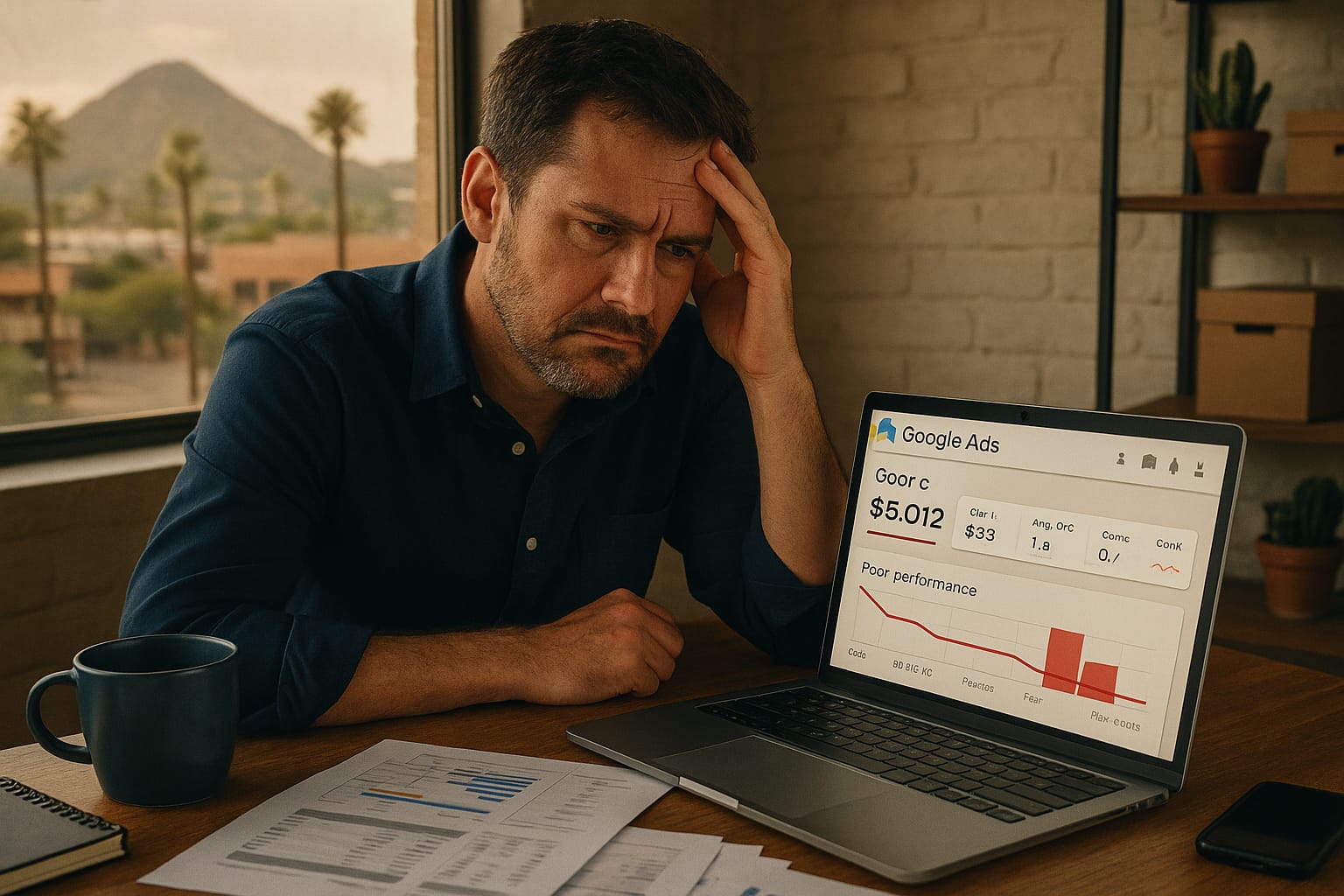
A Phoenix restaurant owner called me in February. He had spent $3,000 on Google Ads in January and had the receipts to show for it: two phone calls. That's it. Two. Phone. Calls.
If you would rather hand it off, see our Google Ads management in Phoenix.
I pulled up his campaign. Within four minutes, I could see exactly what happened. He wasn't unlucky. He wasn't in a bad market. He was making three mistakes that I see constantly with Phoenix small businesses running their own Google Ads — or working with agencies that don't know the local market. And every one of those mistakes was fixable in under 30 days.
If you're spending money on Google Ads right now and you're not seeing real, traceable revenue coming back, read this before you spend another dollar.
Mistake 1: Bidding on Broad Keywords With No Geographic Intent
This is the fastest way to burn budget in the Phoenix market. When you bid on broad or phrase-match keywords without dialing in your geographic intent, Google will happily show your ad to anyone it thinks might be relevant. That includes people in Flagstaff, Tucson, and sometimes cities in other states entirely.
For a local restaurant, that is not a lead. That is a wasted impression and a wasted click at $2 to $8 a pop.
The fix: Use location-specific keywords and pair them with precise radius targeting centered on your actual trade area. "Best lunch near Scottsdale Quarter" converts. "Best lunch restaurant" does not — at least not efficiently. Layer in negative keywords aggressively: if you're a sit-down restaurant, you probably don't want to show for "fast food," "delivery," or "drive-through." Every irrelevant click you eliminate is money that goes toward clicks that actually convert.
Mistake 2: Sending All Traffic to the Homepage
This one kills me every time I see it — and I see it on probably 60% of the campaigns I audit for Phoenix businesses. Someone spent real money building a Google Ads campaign, they're getting clicks, and then they're sending everyone to the homepage.
Your homepage is not a landing page. It was not designed to convert a stranger who just clicked an ad. It was designed to explain your business to someone who already knows you. Those are two completely different jobs.
The fix: Build campaign-specific landing pages. If your ad is for "lunch specials in Scottsdale," your landing page should show your lunch menu, hours, address, a photo of the food, and one clear action: call, reserve a table, or get directions. No navigation menu. No distractions. One offer, one action. In my experience working with Phoenix restaurant and service clients, matching the ad message to a dedicated landing page consistently improves conversion rates by 30 to 60 percent. That's not a small number when you're spending $3,000 a month.
Mistake 3: No Conversion Tracking — Optimizing for Clicks, Not Customers
This is the most expensive mistake because it's invisible. If you're not tracking conversions, you have no idea what's working. You're flying blind and paying for the privilege.
Google Ads will tell you how many clicks you got. It will not tell you, by default, whether any of those clicks turned into a phone call, a reservation, a form fill, or an actual sale. Without that data, you cannot optimize. Google's algorithm cannot optimize either, because it needs signal to know which clicks lead to real outcomes.
The fix: Set up conversion tracking before you spend another dollar. For a local business, this means call tracking (use a dedicated tracking number), form submission tracking, and if applicable, purchase or booking confirmation tracking. Once you have real conversion data flowing in, you can switch to a target CPA or maximize conversions bidding strategy. Now you're not paying for clicks. You're paying for customers. That's a fundamentally different campaign.
The Attribution Point That Changes Everything
Here's the principle that ties all three fixes together: you cannot optimize what you cannot measure.
I talk to Phoenix business owners all the time who have been running Google Ads for months or years without a single clean attribution path from ad click to paying customer. They're guessing. And when you're guessing with ad spend, you're always going to lose to someone who isn't guessing.
Get The Root delivered weekly
We respect your privacy. Unsubscribe at any time.
Every campaign I build starts with the measurement architecture before a single keyword is added. Where does this click need to go? What action do we want them to take? How do we know when they've taken it? What's the actual revenue value of that action? Once you can answer those four questions, you can build a campaign that improves every single month instead of just burning budget.
What a Properly Structured Campaign Actually Looks Like
When I rebuilt that Phoenix restaurant owner's campaign, here's what changed: geo-targeted keywords with 10-mile radius settings, negative keyword lists that eliminated hundreds of irrelevant searches, a dedicated landing page built for lunch service specifically, and call tracking tied to Google's conversion system.
Within 30 days, his cost per call dropped from roughly $1,500 per call to under $60. Same market. Same budget. Completely different structure.
I've seen similar results across Phoenix clients in HVAC, medical practices, and retail. The market isn't the problem. The campaign structure is the problem. And campaign structure is fixable — fast — when you know what to look for.
If you're running Google Ads right now and you're not confident in your attribution, your landing pages, or your keyword targeting, you don't need to keep guessing. You need a clean diagnostic, a clear fix, and a 30-day plan to turn those clicks into actual revenue.
Book a free 30-minute strategy call. I'll pull up your campaign, tell you exactly what's broken, and give you a concrete fix before we hang up. No pitch. No upsell pressure. Just the truth about what's killing your ROI.
See Where Your Business Ranks
Get a free competitive intelligence report. We analyze your website, scan your competitors, and test your AI search visibility, ready in 60 seconds.
Run My Analysis →Did this guide help?
Make our content appear first in your Google Search and AI Overview results by adding us as a preferred source.
Requires signing in to your Google account.
Add Wise Roots as a Google Preferred Source